
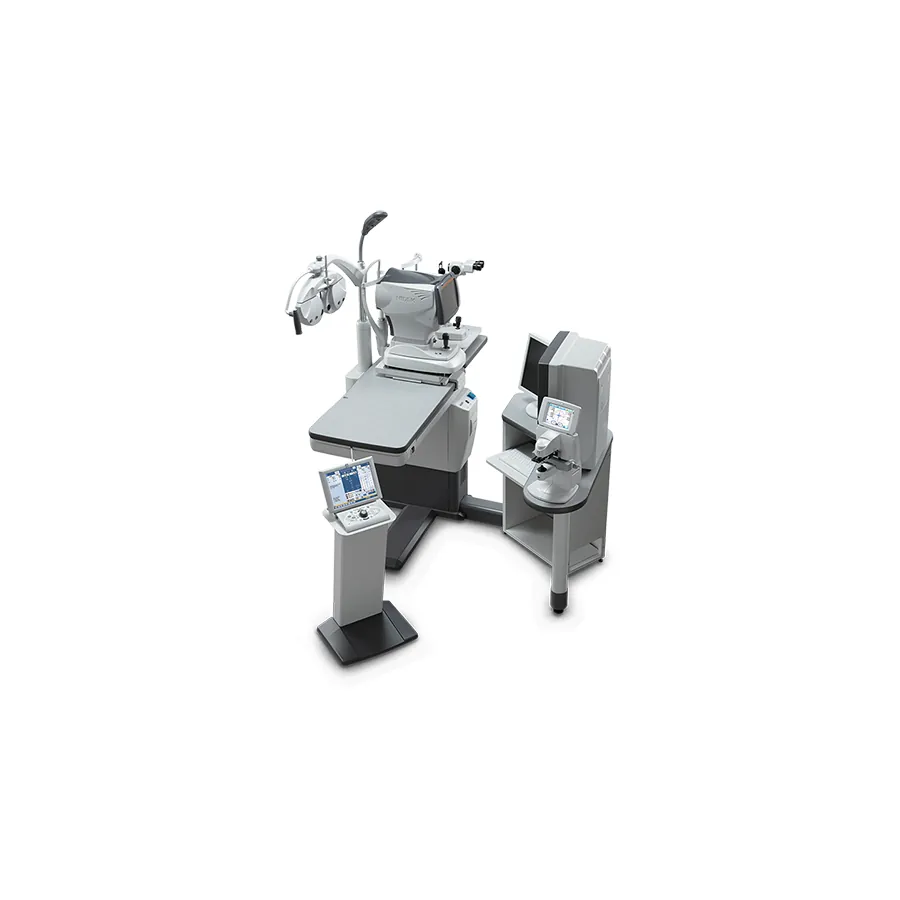
EPIC-6100 Refraction Workstation
The whole pre-test and refraction sequence in a five by six foot space
The EPIC-6100 is the workstation version of Marco's refraction thinking: digital refractor, acuity chart, autorefractor/keratometer, OPD and auto lensmeter combined into one system inside a five-by-six-foot footprint. The patient does not move from device to device, which is where the time goes in most pre-test workflows. Practices running EPIC systems report seeing meaningfully more patients per hour without adding lanes.
What it does
- Custom ARK, NCT, OPD and lensmeter configurations
- Compact 5 ft × 6 ft footprint
- TRS-6100 automated refraction technology at its core
- Effortless vertical adjustment of the main table
- Optional second table for an additional device such as a slit lamp
- OPD wavefront maps displayed for diagnostics and patient education
- Standardized glare and contrast sensitivity testing to support cataract evaluation
- 13.5 JCAHPO credit hours available through the Marco training institute
Is it right for your practice?
Best fit
Growing practices that need more throughput but do not have the square footage or the capital to add another full exam lane.
Why consider it
Adding a lane means construction, another slit lamp, another chair and stand, and more square footage on the lease. The EPIC consolidates digital refractor, acuity chart, autorefractor/keratometer, OPD and auto lensmeter into one seat inside a five-by-six-foot footprint, so the patient does not move from device to device - which is where the time goes in most pre-test workflows. One practice quoted by Marco reports two to four more patients per hour. Standardized glare and contrast sensitivity testing supports cataract evaluation, and OPD wavefront maps come up on the console for the patient to see.
What to compare
This is the largest capital item in Marco's refraction range and it consolidates instruments you may already own. If your pre-test instruments are recent, replacing working equipment to gain adjacency is an expensive way to buy minutes - a TRS-6100 plus the ARK-1 you already have may get most of the benefit. The EPIC earns its price when you are equipping from scratch, replacing several aging instruments at once, or genuinely out of room. Also weigh it against the TS-610, which solves the space problem alone at a fraction of the investment.
Ask me about
Which modules you would configure, what your current pre-test instruments would be worth against it, and whether the 13.5 JCAHPO credit hours through Marco's training institute cover the staff you would put on it.
Specifications
| Spherical Power | -29.00 to +26.75 D (0.12, 0.25, 0.5, 0.75, 1.00, 1.25, 1.50, 1.75, 2.00, 2.25, 2.50, 2.75, / 3.00 D increments) |
|---|---|
| Cylindrical Power | 0.00 to ±8.75 D (0.25/1.00/2.00/3.00 D increments) |
| Cylinder Axis | 0 to 180° (1, 5, 15° increments) |
| Pupillary Distance | Distance PD: 48 to 80 mm / Near PD (35 cm): 50 to 74 mm / Full convergence Distance PD: 54 to 80 mm |
| Prism | 0.00 to 20.00Δ (0.1/0.5/2Δ increments) |
| Auxiliary lenses | Cross cylinder: ±0.25D, ±0.50D, ±0.25 D auto cross / Occluder: Available / Pinhole: 2.0 mm in diameter / Color filter: Right red, Left green / Polarizing filter: Right 135° / Left 45°, Right 45° / Left 135° / Fixed cross cylinder: ±0.50 D (fixed with the Axis set at 90º) / Spherical lens for retinoscope: 0D, +1.5D, +2.0 D (selectable by setting) / Maddox rod (red): Right horizontal, Left vertical / Dispersion prism (fixed): Right 6ΔBU, Left 10ΔBI / Dispersion prism for binocular balance: Right 3-10ΔBD, Left 3-10ΔBU / Dispersion prism for horizontal phoria: Right 3-10ΔBU, Left 3-10ΔBD / Dispersion prism for vertical phoria: Right 5-15ΔBI, Left 5-15ΔBI / Binocular open fogging: 0.00 to +9.00 D |
| Near Gaze Distance | 350 to 700 mm (can be changed in 50 mm increments) |
| Field of Vision | 40° (VD = 12mm) / 39° (VD = 13.75mm) |
| Forehead Rest Adjustment | 25±2 mm |
| Vertex Distance Scale | 12, 13.75, 16, 18, 20 mm |
| Horizontal Level Adjustment | ±2.5° |
| Touch Screen | 10.4-inch color LCD |
| Refractor Head | 16.06 x 4.21 x 10.91” / 7.1 lbs |
| Control Box | 10.23 x 9.06 x 8.15” / 4.6 lbs |
| Relay Box | 7.44 x 8.7 x 2.87 / 3.1 lbs |
| Printer | 3.98 x 3.39 x 4.76 / 1.3 bs |
| Main Table | Dimensions – 39” (W) x 20” (D) x 27” to 34” (H) / Drawer Space – 28” (W) x 9.5” (D) x 2” (H) inside space / Vertical Movement – Motorized |
| Refractor Head Lift Arm / Vertical Movement Range | 25” to 37” from the top of the table |
| Near Point Lamp / Light Source | White LED |
| Full Dimensions and Weight | 39” (W) x 62” (D) x 52” to 71” (H), 264.5 lbs |
| Power Supply | Voltage – 100 to 120 V AC / Frequency – 50/60 Hz / Power Consumption – 600 VA at maximum (including power consumption of connected devices) |
Worth comparing
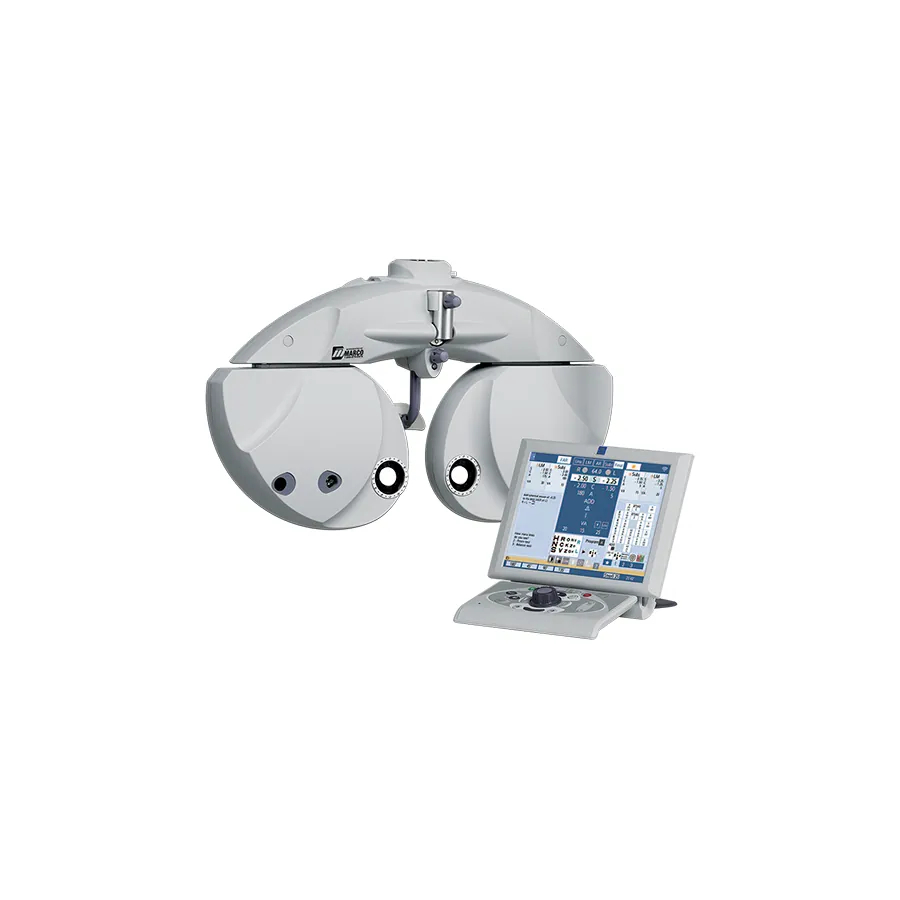
TRS-6100 Digital Refractor
Automated refraction with a remote touchscreen and ergonomic keyboard, operable with one hand. Shows the patient their current and new prescription side by side.
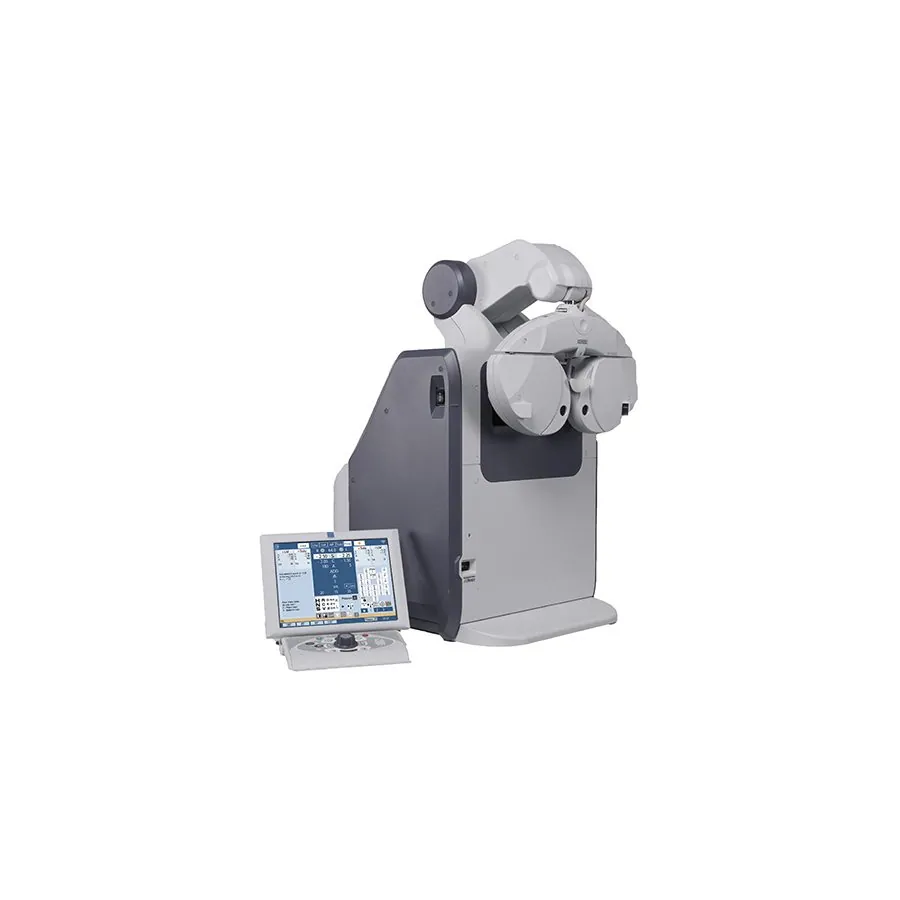
TS-610 Tabletop Refractor & Chart System
Chart and TRS-6100 refractor integrated into one tabletop unit. The FARS configuration adds voice-guided testing the patient runs themselves, with the practitioner completing a final check.
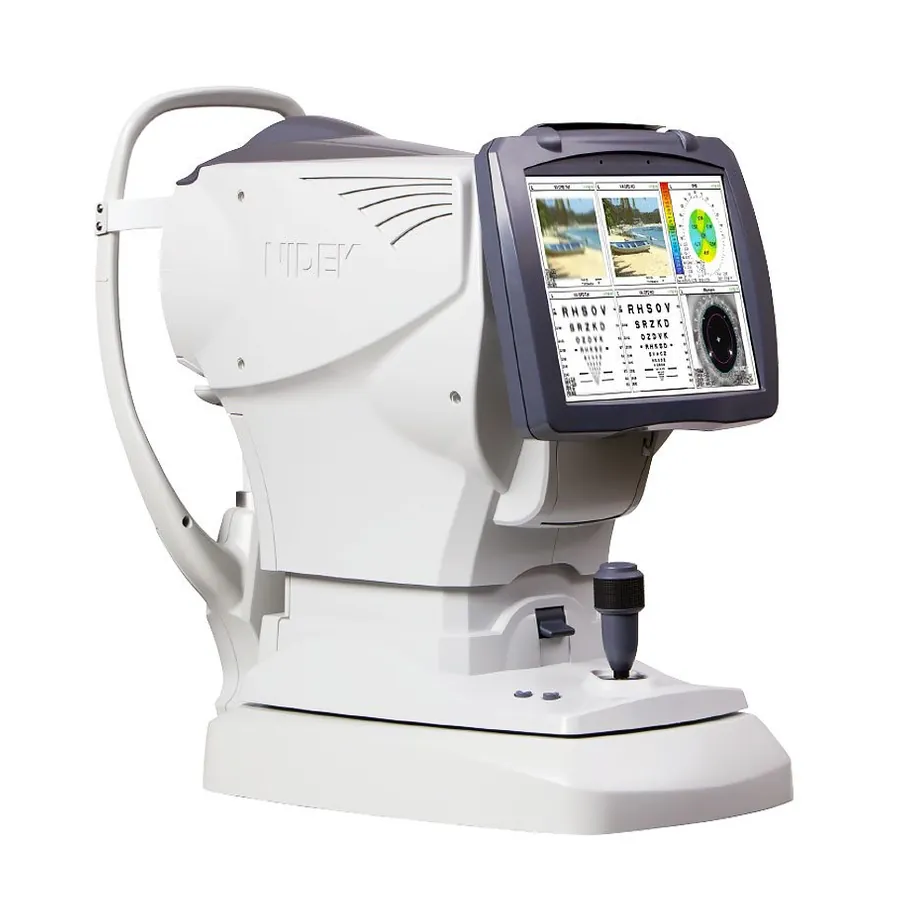
OPD-Scan III Wavefront Aberrometer
Autorefractor, keratometer, pupillometer, corneal topographer and wavefront aberrometer in one instrument, capturing over 20 diagnostic measurements in roughly ten seconds per eye.
Specifications reviewed: 2026-09-06
Manufacturer source:
Marco: EPIC-6100 Refraction Workstation.
Configurations and specifications change. Ask me to confirm before ordering.
Talk it through with me
Tell me how your practice handles this now and what you want it to do, and we can work through the options together. You do not need to have settled on a product first.